

 1. Strategic Context: The Digital Imperative for Industrial Assets
In the current era of Industry 4.0, the transition from isolated serial communication to integrated Industrial Ethernet is no longer optional; it is a strategic necessity for remaining competitive. For many enterprises, the factory floor remains populated with functional but "silent" legacy equipment utilizing RS232 or RS485 protocols. Modernizing these assets is essential to unlock the data required for smart manufacturing and predictive analytics.
2. Analysis of the Connectivity Gap: Challenges in Legacy Equipment Integration
Identifying and removing data silos is the first step in any successful digital transformation. Traditional industrial environments often suffer from fragmented communication layers where valuable operational data is trapped within individual machines. Based on field analysis, several core pain points hinder effective integration:
- Protocol Fragmentation: Legacy equipment relies on RS232 and RS485 serial protocols, which cannot natively communicate with modern TCP/IP-based high-speed Ethernet networks.
- Interoperability Barriers: Traditional sensors, PLCs, and laboratory instruments lack the interface capability to feed data directly into enterprise-level MES or SCADA systems.
- Cabinet Infrastructure Constraints: Modernizing a facility with multiple single-port converters leads to cluttered control cabinets, complex wiring management, and increased points of failure.
These barriers prevent real-time data transparency, forcing management to rely on delayed or manual reporting. To overcome this, a unified architectural solution is required to consolidate disparate field signals into a single, high-reliability data stream.
3. The HT-804 System Architecture: From Field to Cloud
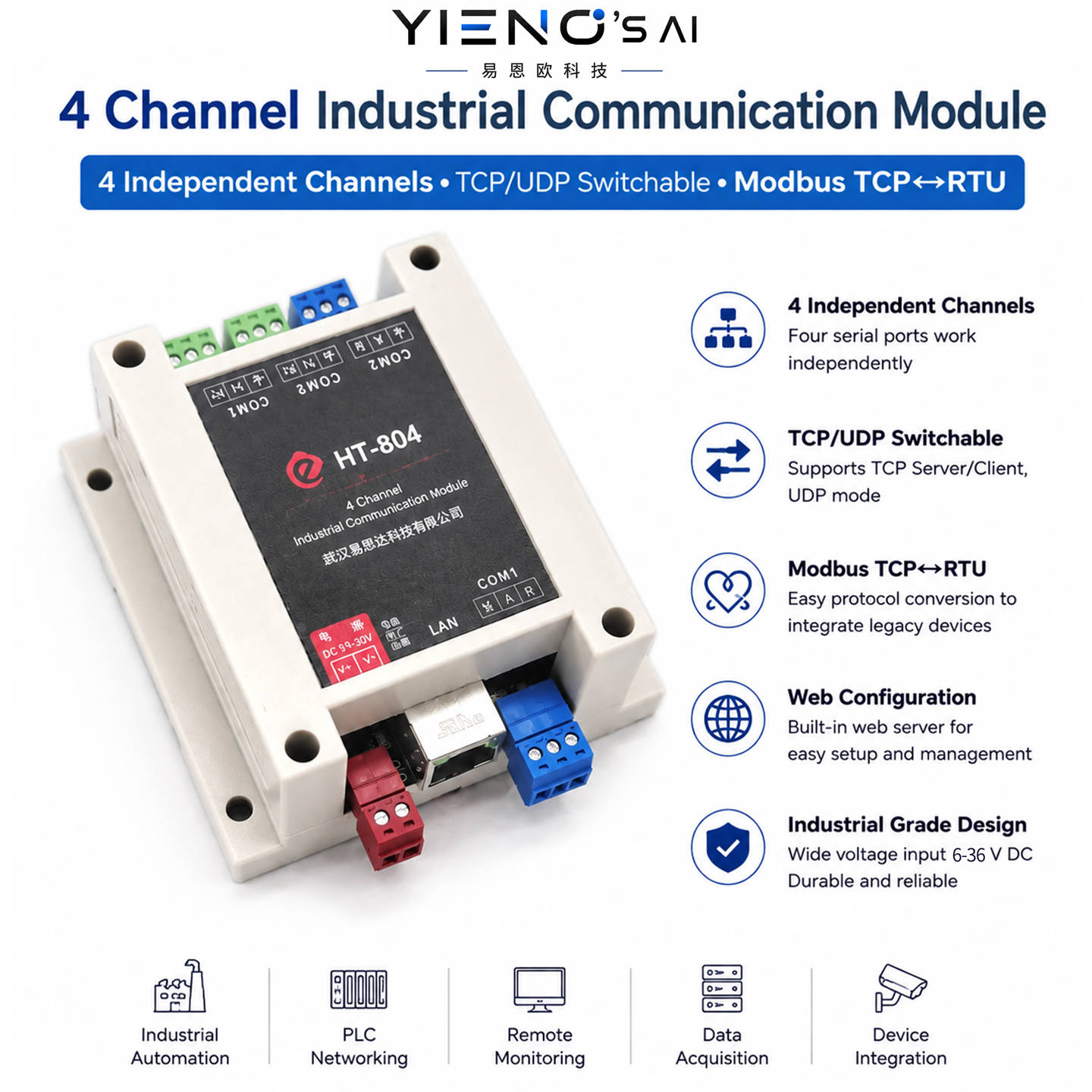
A "Multi-Channel Gateway Architecture" is vital for simplifying network topology. Rather than managing multiple individual converters, the HT-804 consolidates four serial streams into a single high-performance node. Crucially, every communication channel operates as an independent network node, ensuring that a failure or configuration change on one legacy device does not disrupt the data integrity of the others.
The system facilitates data flow through four distinct levels:
- Field Level: Direct connection of field-side devices via four independent ports. Per the hardware design, COM1 and COM2 are dedicated RS485 interfaces, while COM3 and COM4 are dedicated RS232 interfaces. This allows for the simultaneous integration of PLCs, smart meters, and laboratory analysis equipment.
- Gateway Level (HT-804): Data processing is managed by the high-performance STM32F303CBT6 processor. This stage handles protocol processing and critical conversion, such as Modbus RTU to Modbus TCP.
- Network Level: Reliable Ethernet transmission is established using four independent Socket engines. This "Independent Socket Architecture" provides a dedicated virtual server/client for each physical port, preventing cross-channel interference.
- Application Level: Processed data is delivered to higher-level systems, including SCADA monitoring stations, MES databases, or Cloud Platforms.
Technical Specifications for Integration
| Parameter | Specification |
| Model | HT-804 |
| Processor | STM32F303CBT6 |
| Interface Mapping | COM1/2 (RS485), COM3/4 (RS232) |
| Network Interface | 10/100M Ethernet |
| Power Supply | 6 ~ 36V DC (Wide Voltage) with Anti-Reverse Protection |
| Physical Terminals | 3.81mm Pluggable Industrial Terminals |
| Mounting | Standard DIN35 Rail |
| Configuration | WEB-based (No specialized software required) |
This robust architecture ensures that technical specifications translate directly into functional advantages for the end-user.
4. Evaluation of Key Differentiators and Competitive Impact
In complex system integration, hardware reliability and port density are the primary drivers of project success. The HT-804 distinguishes itself through several key features designed for the rigors of the industrial environment:
- Independent 4-Channel Design: The module supports simultaneous, non-interfering communication across its four ports. This high density optimizes control cabinet space by replacing up to four single-port converters with a single unit, reducing both footprint and power consumption.
- Versatile Network Modes:
- TCP Server: The module listens for connections from a master SCADA system.
- TCP Client: The module actively reports data to a designated server/MES.
- UDP: Optimized for high-speed, real-time data exchange where low latency is the priority.
- Industrial-Grade Reliability: Beyond its wide-voltage support, the HT-804 utilizes 3.81mm pluggable terminals for easier maintenance and secure wiring. Integrated anti-reverse protection and ESD protection safeguard the internal STM32 architecture from electrical instability common in heavy industrial settings, significantly lowering the Total Cost of Ownership (TCO).
5. The "So What?" Layer: Cost-Benefit Analysis and Digital Value
Strategic digital upgrades must be evaluated through the lens of ROI. The HT-804 provides immediate value through three primary pillars:
- Asset Life Extension: By bridging legacy RS232/485 devices to Ethernet, companies avoid the massive Capital Expenditure (CapEx) required to replace functional machinery simply for the sake of connectivity.
- Integration Efficiency: The WEB-based configuration and plug-and-play terminal design reduce labor hours for system integrators. The ability to configure every channel independently allows for a "set and forget" deployment model.
- Data-Driven Decision Making: Moving from manual data logging to automated, real-time acquisition provides the granular visibility needed for smart production scheduling and predictive maintenance, moving the factory toward a "Future-Ready" status.
6. Engineering Implementation and Deployment Strategy
Streamlined deployment is essential to minimize production downtime. System integrators should follow this standardized framework for commissioning the HT-804:
- Environment Preparation: Ensure hardware availability, including a Windows PC and Ethernet cabling. Utilize professional debugging tools such as Modbus Poll/Slave and the "Communication Cat" (通讯猫) utility for signal verification.
- Configuration: Access the built-in Web UI (Default IP: 192.168.3.17).
- CRITICAL ENGINEER NOTE: The WEB interface shares port 5001 with COM1. If the COM1 communication port is modified, the WEB access port must be updated accordingly to maintain access.
- Validation: Test Modbus TCP/RTU conversion and ensure baud rates, parity, and stop bits match the field device precisely.
Troubleshooting Framework
| Issue | Primary Checkpoints |
| Cannot Access WEB UI | Verify PC is on the same 192.168.3.x segment; check if Port 5001 was changed via COM1 settings. |
| Communication Failure | Verify physical wiring (RS232 vs RS485); check Baud Rate and Parity (校验方式). |
| No Modbus Data | Confirm Slave Address (设备地址) and verify correct Register Settings in the master software. |
| Channel Instability | Ensure unique network ports are assigned to each of the four independent Socket engines. |
7. Conclusion: Empowering the Future-Ready Factory
The HT-804 Industrial Communication Gateway represents a strategic pivot for manufacturers. It is more than a protocol converter; it is the fundamental infrastructure for a connected enterprise. By operating as four separate virtual servers within a single industrial-grade chassis, it provides the reliability and isolation required for mission-critical data acquisition.
Expert Recommendation: For system integrators and digital transformation officers, the HT-804 is the optimal choice for immediate upgrade projects. Its combination of high port density, independent socket architecture, and robust ESD protection offers the most reliable path to modernizing legacy assets while minimizing both initial CapEx and long-term maintenance costs. Seamless connectivity is the cornerstone of the modern factory; the HT-804 provides that foundation today.